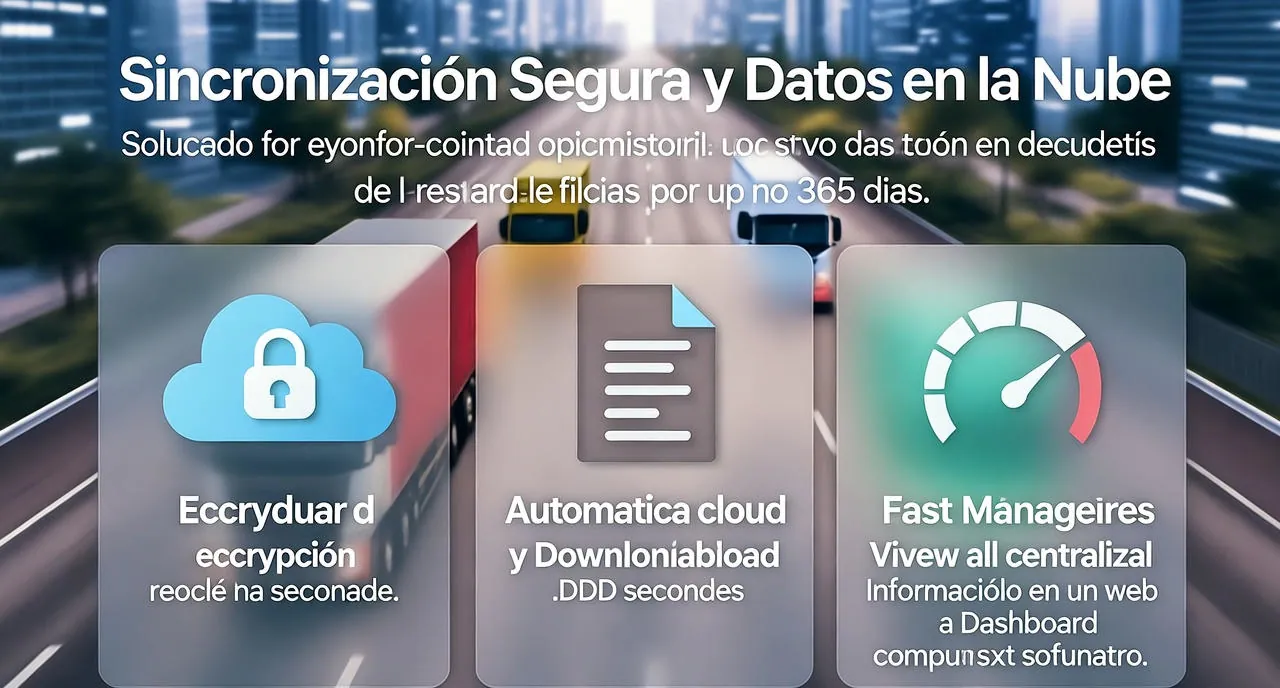
The TachoTools Ecosystem features a high-security automated synchronization engine designed to protect the integrity of your transport records. We provide encrypted cloud storage that ensures your .DDD files are preserved for the mandatory 365-day retention period, accessible anytime from any authorized device.
Wireless Efficiency for Fleet Management
By utilizing our cloud-native architecture, drivers and fleet managers can operate in a frictionless, paperless environment. Tachograph files are uploaded directly from the vehicle or smartphone via our Mobile APK, allowing administrators to monitor activity through a centralized web management dashboard in real-time.
TachoTools implements AES-256 encryption protocols—the same standard used by financial institutions—compliant with the General Data Protection Regulation (GDPR). This guarantees that sensitive driver activity logs and company records are shielded from unauthorized access while maintaining a full, immutable audit trail for transport authorities.
The Architecture of Reliability
End-to-End Encryption
All data packets are encrypted both in transit (SSL/TLS) and at rest, ensuring zero-knowledge privacy for your fleet records.
Ubiquitous Access
Retrieve, download, or visualize your files 24/7 via any web browser, tablet, or smartphone without installing local drivers.
Legal Compliance
Automated protocols ensure file retention for the full statutory year, protecting you from "missing data" fines during labor inspections.
Zero-Manual Sync
Background upload queues prevent data loss in areas with poor connectivity. Files sync automatically when a signal is restored.
Compliance Ready: Peace of Mind for Logistics
Secure synchronization is more than a backup—it is a critical component of your regulatory compliance strategy. TachoTools ensures that your business is always audit-ready. Whether it is a routine roadside inspection or a complex labor audit, your files are organized, verified, and ready for immediate analysis and reporting.
A convenient copy is not a legal archive
This distinction belongs at the start, because everything else depends on it. You can have a good copy and still have no archive.
- What proves anything is the original file downloaded from card or vehicle unit, with its digital signature intact. Not a report, not a chart, not a PDF.
- The duty covers two sources. Driver card and vehicle unit are separate downloads; one does not stand in for the other.
- Continuity is part of the proof. A pile of files with a hole in the middle is a pile of files, not an archive.
So the useful question isn't "do we have a copy?". It's can we evidence an unbroken period for every driver and every vehicle? That one gets a yes considerably less often.
The memory overwrites itself without warning
The most common cause of irreversible data loss isn't a fault. It's time passing. Storage in the unit and on the card is finite, and once full the oldest data is written over — no message, no prompt, no trace.
So data is lost quietly. There's no day on which something fails; there's a day on which somebody asks for a record from six months ago and it doesn't exist. And it can't be restored from any backup, because what was overwritten was the source, inside the vehicle.
This defeats the argument you hear most often — "but we take backups". A backup protects against a failed disk. It does not protect against a period nobody ever pulled off the vehicle, because that period never became part of the set. Which is why the download interval matters more than any other decision about the archive.
Four questions, fifteen minutes, once a month
An archive doesn't break with a bang. It breaks quietly: one vehicle falls out of the cycle, a driver comes back from long-term absence, a sync stops working — and for six months nobody notices. Which is why only a short, regular check works:
- Does every vehicle have a download in this period? Checked against the vehicle list, not the file list.
- Does every driver have a card download? Including the occasional drivers — they drop out first.
- Do the periods join up without gaps?
- Do the files open? A backup nobody has ever restored is an assumption, not a backup.
That's the whole of "data security" in the version that counts at an inspection — and the only version that catches a problem while it can still be fixed.
Who answers when files are missing
A question that usually gets asked mid-inspection, by which point it's already framed wrongly. The answer is straightforward: the duty to download and retain sits with the operator, regardless of who was engaged to handle the IT and where the disks physically live.
A contract with a supplier governs the relationship between two businesses. It does not transfer the regulatory duty — the authority asks the operator and expects the files from the operator. That a third party failed is something resolved afterwards and separately.
Which gives an uncomfortable conclusion that saves money: delegate the task, keep the control. Looking at the list of completed downloads once a month isn't distrust of the supplier — it's the difference between learning about a gap before the inspection or during it.
In short
Syncing solves convenience. The archive is solved by rhythm — a fixed day, both sources, originals kept, and one short check that the periods still join up.
Your files are your drivers' personal data
The part most often overlooked when setting up synchronisation. A tachograph file contains a named person's hours, their card number and, on newer units, positions. That makes the archive a processing of personal data, with two requirements pulling in different directions:
- Transport rules require you to retain the data and be able to produce it.
- Data protection requires you to protect it, limit who gets in, and not spread it further than necessary.
No contradiction, but an uncomfortable conclusion: "put it all in a shared folder so everyone can reach it" answers both requirements badly at once. Access to a driver's file belongs to whoever needs it for payroll or planning, not to the whole office.
And the same point from the other side: the driver is entitled to know what happens to his data. An operator who can explain it in two sentences has an easy time at any inspection; one who doesn't know where the files are has a problem before anyone asks.
For Fleet Managers
Monitor live team activity and prevent the steep penalties associated with overdue data downloads.
For Owner-Operators
Maintain a permanent, secure personal digital record of your professional history, independent of your employer.
For Consultants
Access auditable data across multiple client accounts with total traceability and centralized reporting.
Protect Your Fleet’s Future
Stop worrying about hardware failure or storage deadlines. Let TachoTools manage your digital records with professional precision.
Related: DDD Archiving | Penalty Prevention | Enterprise Plans