Every day, digital tachographs generate thousands of encrypted entries: speeds, driving times, rest periods, and driver activities. Interpreting this Big Data manually is not only slow and costly but prone to "human error" liabilities that expose your business to costly legal risks.
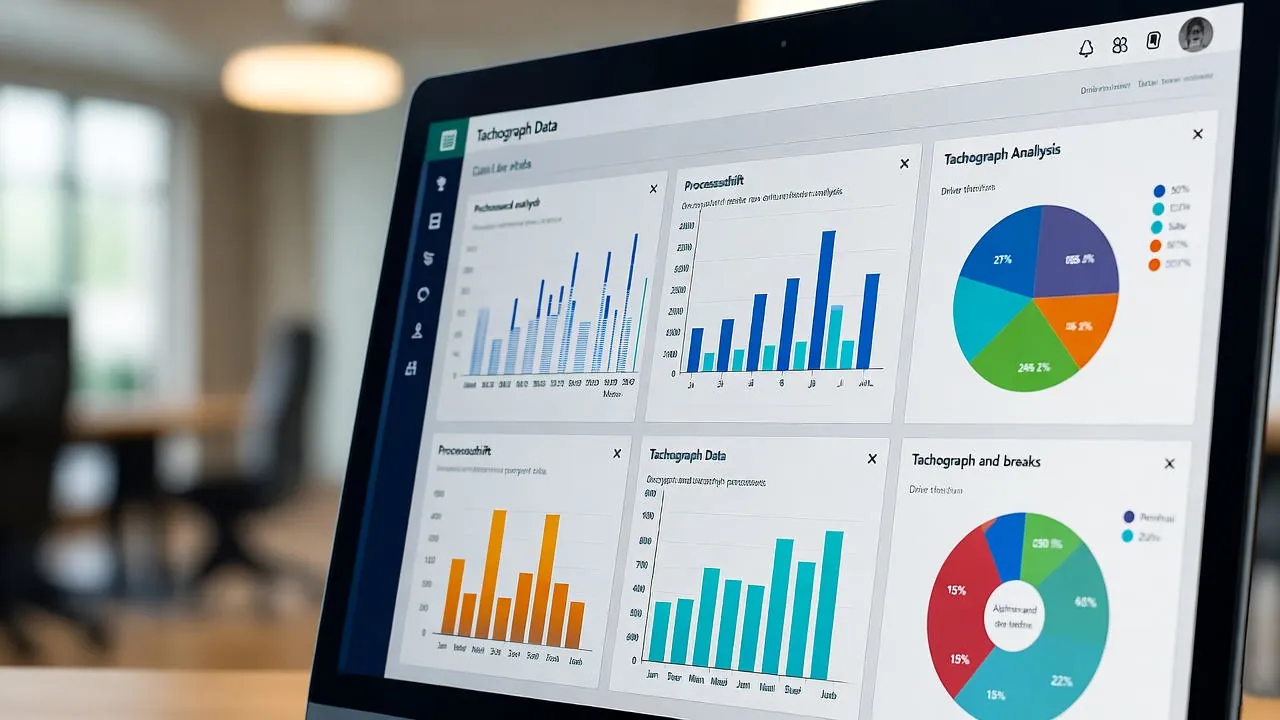
TachoTools acts as a forensic layer between raw data and your management team. Our
platform combines AI-powered processing and machine-learning
algorithms to automatically decode complex .DDD files, delivering
intelligent dashboards that improve decision-making across the entire logistics chain.
Advanced Compliance & Reporting Capabilities
Our system doesn't just read files; it performs a deep-dive analysis into the operational health of your fleet:
- Sub-second Decoding: Process .DDD, .V1B, and .C1B files instantly.
- Behavioral Metrics: Generate custom reports by driver, vehicle, or cross-border route.
- Infringement Detection: Early identification of Regulation (EC) 561/2006 breaches.
- Predictive Alerts: Real-time notifications for missing rest periods or driving excesses.
Business ROI: Beyond Compliance
Transforming your data into intelligence provides a measurable Competitive Advantage:
Cost Reduction
Automate thousands of hours of manual administrative review and eliminate the budget reserved for transport fines.
Route Optimization
Plan shifts and overnight stays based on real-time driver availability data, not estimates.
Technical Workflow: How It Works
Simply upload your files via our encrypted API or the TachoTools Mobile App. Our AI engine performs a forensic validation, populating your dashboard with predictive alerts and audit-ready reports available from any device, anywhere in the world.
A report has two audiences, and they ask different questions
Most reporting fails not on the technology but because it was written for nobody in particular. A tachograph report has two readers, and they want entirely different things.
- The driver asks: where does this figure come from — which days, which hours? He wants to recognise his own week in it.
- The examiner asks: does this match the records? Not the number — the chain behind the number.
Which gives the only workable test of quality: a report is good when you can travel from the figure back to the day and the underlying record, and forward again. Everything else is presentation.
Five things decide whether an analysis closes an argument or starts one: the exact period with start and end dates; the source of each figure — card, vehicle unit or manual entry; the gaps shown as gaps, because a missing day must not look like a quiet day; the calculation rule where anything is rounded; and the date of the last download, which is how far the picture actually reaches.
When the numbers don't match
A gap between what the driver worked out in his head and what the report says is normal and nearly always explainable. It only becomes a problem when nobody can show where it came from. The order of checking is always the same, and it starts at the source, not at the total.
- The record first. Do the days and hours in the file match what both sides remember? This is usually where a missing manual entry or a day with the card out turns up.
- Then the transfer into the analysis — complete, or with a gap.
- The calculation last. Only here is it worth asking about the formula.
In nine cases out of ten the difference sits in the first or second step. Which is why a conversation that opens with "let's look at that day in the record together" almost always ends quickly, and one that opens with "you've got my hours wrong" almost never does.
In short
A report isn't good because it impresses. It's good when the driver recognises his own week in it and an examiner can follow the chain back to the file. Both at once, and the subject is closed.
Why transparency helps the operator more than the driver
Traceable reporting is usually framed as a courtesy to the workforce. Arithmetically it's the other way round. A calculation that can't be reconstructed is an argument waiting for an occasion — and reconstruct it you will have to, only later and in worse circumstances.
Three habits close the subject for good:
- The same layout every month. Changing the names of line items generates questions even when the figures are right.
- Pay and expense reimbursement shown separately. Rolled into one line they can be explained to neither the driver nor an inspector.
- Ongoing access for the driver to his own hours — not once a year on request. Most disputes don't arise over the amount; they arise because it couldn't be checked.
What a report cannot tell you
Worth saying plainly, because good tools get a bad name when they're asked for what they can't give. An analysis works with what was recorded and what has been downloaded. Three things sit outside that:
- What was never recorded. Driving without a card doesn't show as an error; it shows as nothing. It surfaces only against the vehicle unit.
- What hasn't been downloaded yet. The best analysis ends at the date of the last download — which is why the interval matters more than the tool.
- Why something happened. Whether an overrun came from the planning, a closed road or three hours on a bay isn't in any file. Only somebody who was there can answer that.
That last point is the practical one: the report supplies the question, not the answer. It shows where to look; what changes afterwards changes in the planning, not in the software.
Working time and driving time are two different counters
The commonest reporting error isn't arithmetic. It's merging two quantities that run side by side and have separate limits.
- Driving time is governed by the drivers' hours rules. It sits in the unit.
- Working time is governed by working time law — and covers considerably more: loading and unloading, vehicle checks, paperwork, waiting on call.
So a week can be flawless on driving time and too long on working time. The loading bay appears in no driving-time analysis, yet it is frequently what tips the balance.
A report showing only driving time therefore answers half the question. Only both counters side by side make a week plannable — and prepare you for both kinds of scrutiny rather than just one.
Turn Your Data Into a Strategic Advantage
Request a free enterprise demo and discover how TachoTools can automate control and safety across your entire fleet.